When people long for vision as I've defined it in these posts, it is not because they are physically blind. This is obvious, but it bears repeating. People are generally capable of seeing what is around them, but they often cannot grasp the meaning, value, and significance of what they are seeing. In large part, that is what vision is.
Some think and teach that any person can attain vision if they simply look more closely, more intently, more methodically, more deliberately at the world around them, if they don't just see but look at the world that passes before their eyes continually. There is a good deal of truth to this. I remember in a seminary class being assigned to list 75 factual (and thus easily demonstrable) observations about one verse in the Bible. It sounds impossible (and actually, I think it was), but it was amazing how much detail one can see if one takes the time to look at it. And from detail may spring insight.
But insight is not guaranteed. When it comes to seeing God's vision, close observation of the world he made and silently orders and directs may be a strong preparation for vision, and if God blesses someone with vision it may come through their close observation of the world—but only if God blesses them, only if he intervenes supernaturally. A person may spend a lifetime observing nature far more carefully than the average person does and yet never see God's nature reflected in it. A person may spend a lifetime scrutinizing the Bible far more than the average person does and yet never see the glory of God reflected in the face of the Christ revealed on every page. A church may spend thousands of dollars and man-hours gathering data about their community or target demographic and yet never see the ripened grain and the lost sheep and why it matters so much to God to bring them in or what bringing them in actually means.
Vision is truly seeing what is in front of your physical eyes, but true vision doesn't come merely by looking harder. It comes from a spiritual revelation that by default every person lacks, that only God bestows, that opens the eyes to see.
Thursday, December 27, 2012


Monday, December 24, 2012
The Vision Thing (2): Seeing God through Jesus
No one can have God's vision without first gaining a vision of God. But there's a problem: no one can have a vision of God, not a full and unobscured one anyway. God "lives in unapproachable light, whom no human has ever seen or is able to see" (1 Tim. 6:16). "No one has ever seen God," says John. But the good news is that "[t]he only one, himself God, who is in closest fellowship with the Father, has made God known" (John 1:18). "We saw his glory—the glory of the one and only, full of grace and truth, who came from the Father" (v. 14, emphasis mine). Whose glory? Jesus', the Word become flesh.
As "the radiance of [God's] glory and the representation of his essence" (Heb. 1:3), the Son's glory is the glory of the Father. In fact, it might be appropriate to say that the Son himself is the glory of the Father. But because of the incomprehensible fact of the Son's incarnation, we are able to see the Son even though the Father is hidden from us in light. Because the Son is exactly like the Father and represents him perfectly—all that is true of one is true of the other except that the Son is fathered by the Father—when we see Jesus the Son, we see God the Father. "[T]he one who sees me sees the one who sent me," Jesus said (John 12:45). "The person who has seen me has seen the Father" (14:9).
But a great difficulty appears. It seems impossible that we who cannot see Jesus with our eyes the way Jesus' twelve disciples did are able to see the Father. But after Jesus ascended to heaven God made a way that all people could see his Son. "God, who said 'Let light shine out of darkness,' is the one who shined in our hearts to give us the light of the glorious knowledge of God in the face of Christ" (2 Cor. 4:6). God implants the face of Christ, the radiance of God's glory, inside people's psyches so that even though they don't see him with their eyes, they see him just the same.
Furthermore, everyone who sees the Son not only sees the Father but also sees the Holy Spirit, and vice versa. "[T]he world . . . does not see him or know him," Jesus told the Twelve, but they saw and knew him, because he was with them in Jesus "and will be in you" (John 14:17). So the person with the Spirit within "sees" the Spirit, by seeing him sees the Son, and by seeing the Son sees the Father who cannot be seen.
Therefore, anyone who wants true vision, who wants to see things the way God sees them, has to begin by fixing their eyes on Jesus, because this is the only way to see the God who is the beginning and the end of all true vision. And steadily viewing Jesus is not possible without the knowledge that comes by the Holy Spirit.
So how does one get the Holy Spirit? That's easy—you just have to ask the Father! But I believe it's important (more for yourself than for him) to specify just what you're asking for. You are not asking for the Holy Spirit so that you can have a vision of what to do. You must ask for the Holy Spirit to give you a vision of the Son of God, the Word, so that in him you would see the Father. When the sole vision you crave is a vision of the Father, he will give it—and with it much more vision besides.
Thursday, December 20, 2012
The Vision Thing (1): Seeing God

Eugene Pluchart, God Appears to Moses as a Spirit in the Burning Bush (1848)
When churches (or other organizations or individuals) first grasp their need for vision, when you first hear people in them say something like, “We need vision,” it’s usually closely followed by something like, “ . . . because need to know what to do.” This is both right and wrong.
It is right because, for one, vision (as defined previously) usually (though not always) requires people to do something. It is also right because usually the people who say, “We need to know what to do,” truly don’t know what to do and really ought to be doing something different from what they’re doing.
But it is also wrong. If your attention to vision is entirely focused on what you are supposed to do, you will never find it and you are likely to make great mistakes.
Remember that vision, true vision, is what God sees. And what God sees first of all is himself.
In fact, there is a recurring pattern in Scripture, especially in the first ten books of the Bible, that we can expect of a true vision from God. Let’s look at Moses as an example.
In Exodus 3, as Moses, Pharaoh’s-adopted-son-turned-fugitive-shepherd is tending to the flock in the wilderness, he sees a bush on fire that doesn’t burn up. When he comes closer, God reveals that it is he, intoning, “I am the God of your father, the God of Abraham, the God of Isaac, and the God of Jacob” (v. 6) So the first thing that Moses has a vision of is God himself.
Then God continues,
I have surely seen the affliction of my people who are in Egypt. I have heard their cry because of their taskmasters, for I know their sorrows. I have come down to deliver them from the hand of the Egyptians and to bring them up from that land to a land that is both good and spacious, to a land flowing with milk and honey, to the region of the Canaanites, Hittites, Amorites, Perizzites, Hivites, and Jebusites [vv. 7-8].Note that what God is telling Moses here is what God has been up to and what he plans to do next. So the second thing that Moses has a vision of is what God is doing.
It is only then that God says to Moses, “So now go, and I will send you to Pharaoh to bring my people, the Israelites, out of Egypt” (v. 10). Now at last, finally, the third thing that Moses has a vision of is what he is supposed to do.
To repeat, the pattern of vision is
- God himself
- what God is doing
- what we are supposed to do
Now see that Moses was both right and wrong. He did correctly hear his assignment—that was truly part of the vision—but he starts at the end: what he is supposed to do. That was the focus, as it ever is with us most of the time.
God addresses Moses’ concern by assuring Moses that he would be with him (v. 12), which also reminded him that God is really the one bringing the Israelites out of Egypt. Then God repeats the pattern of vision over again to see that Moses gets it.
- In vv. 14-15 God reveals again who he is, God himself (“I Am Who I Am”).
- In vv. 16-17, he tells Moses to bring together Israel’s elders and tell them what God is doing (“I have attended carefully to you . . . I will bring you up”).
- Then in v. 18 God tells Moses what he is supposed to do with the elders (“go to the king of Egypt and tell him . . . ”).
You can see the same pattern of a true vision in a number of places. You see it with Abraham, Jacob, Joshua, Manoah, and Samuel. And you see it with Jesus. Jesus, himself God, the only one who had seen God the Father completely (John 1:18), said,
I tell you the solemn truth, the Son can do nothing on his own initiative, but only what he sees the Father doing. For whatever the Father does, the Son does likewise. For the Father loves the Son and shows him everything he does, and will show him greater deeds than these, so that you will be amazed. For just as the Father raises the dead and gives them life, so also the Son gives life to whomever he wishes [John 5:19-21].So even the vision that Jesus, the Son of God, had was first of God himself, then of what God is doing, then of what he is supposed to do.
The bent of humanity—the bent of sin—is to focus so intently on ourselves that even when we want to do good for God or others (or are called to it like it or not), we still focus on ourselves. But if you truly seek vision, the first thing is to surrender your attention to what you are supposed to do. Don’t even seek what God is doing. The first and most important thing to see is God himself. That’s where true vision begins.
Tuesday, December 18, 2012
The Vision Thing (intro)
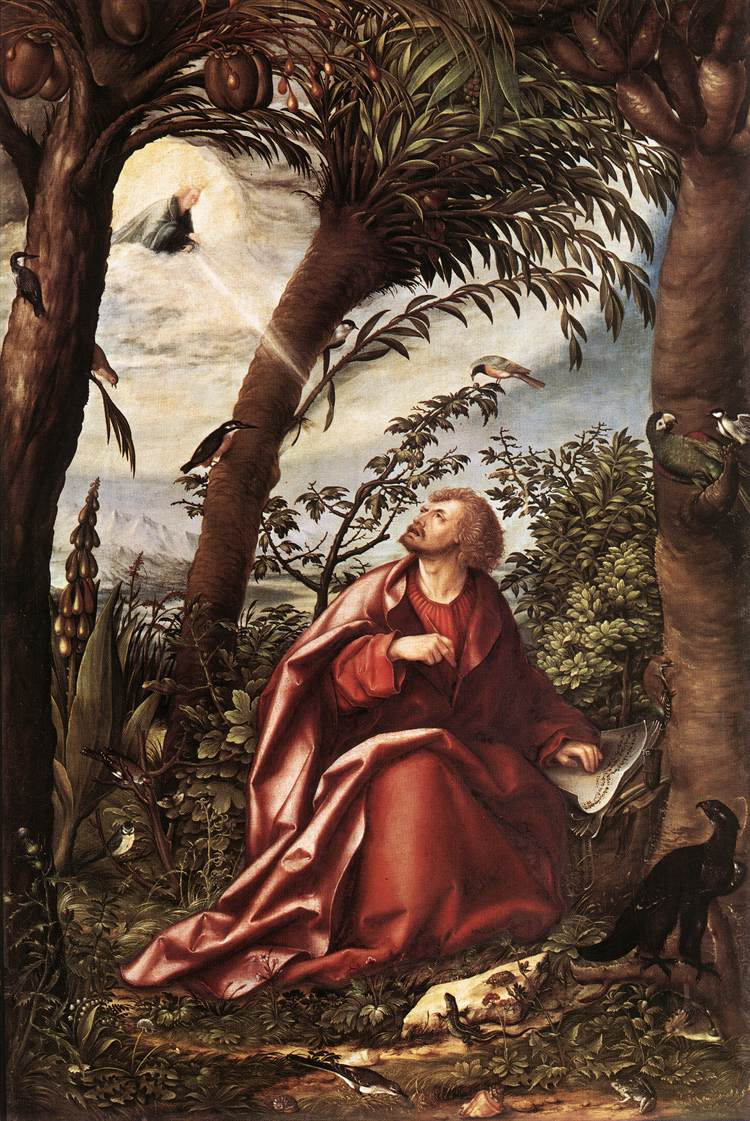
Hans Burgkmair, St. John Altarpiece: St. John the Evangelist in Patmos (1518)
Vision is cool. We want it from our leaders. Companies want it for themselves. Churches want it too. And when I say that vision is cool, I don’t just mean that vision is hip and trendy. I mean that vision really is cool when you have it or when you’re around people who have it or are in an organization that has it. As Will Mancini puts it, “[Vision] clarity isn’t everything, but it changes everything.”
A chosen group in my church is seeking greater vision clarity, and we are in a methodical process to discover it. Very helpfully, we began that process by going to the Bible to see what it says about vision. As it happens, it says quite a lot.
Stemming from my investigation of what the Bible says, I’m going to post 29 short, biblical meditations on vision. I’m defining vision as “human beings’ spiritual ‘sight’ to see things the way God does.” Before you pursue your vision, check out what God says about the vision thing.
Friday, December 14, 2012
Justification
Justification is not the entirety of salvation, but it is an essential component of it.
What is justification? The declaration that a person is innocent in the sight of God.
Who/what justifies? God the Father.
Why does he justify? His grace. (Note: “Grace” in the Bible may mean either the giver’s generous disposition or the gift itself. The former is meant here.)
How can he justify? The death, resurrection, and ascension of his Son, Jesus Christ, on people’s behalf and in their place.
Whom does he justify? People who place their sole hope for justification in Jesus (also known as “faith”) and profess it.
What is the evidence of justification? The believer’s obedience to the will of God.
Who/what produces that evidence? The Holy Spirit of God living in the believer.
This is the classic Protestant teaching on justification. The Protestant view and mine is that addition, subtraction, or modification of the substance (not mere wording) of these answers is not only an error but probably a fatal one.
What is justification? The declaration that a person is innocent in the sight of God.
Who/what justifies? God the Father.
Why does he justify? His grace. (Note: “Grace” in the Bible may mean either the giver’s generous disposition or the gift itself. The former is meant here.)
How can he justify? The death, resurrection, and ascension of his Son, Jesus Christ, on people’s behalf and in their place.
Whom does he justify? People who place their sole hope for justification in Jesus (also known as “faith”) and profess it.
What is the evidence of justification? The believer’s obedience to the will of God.
Who/what produces that evidence? The Holy Spirit of God living in the believer.
This is the classic Protestant teaching on justification. The Protestant view and mine is that addition, subtraction, or modification of the substance (not mere wording) of these answers is not only an error but probably a fatal one.
Friday, December 7, 2012
You Must Read This Article (Not Mine)
Earlier this year I reposted my thoughts from last year on same-sex marriage. My friend strangedavid made the post better by thoughtfully pushing back in the comments section and driving me to explain more. Though I did not retreat from my argument from Christian theology that same-sex marriage is a contradiction in terms, strangedavid forced me to admit that my secondary, secular arguments against same-sex marriage were weaker—as I put it, not a “stop sign” but a “speed bump.”
For this reason I’d like to introduce you to a secular stop sign. In their landmark article “What Is Marriage?” in the Harvard Journal of Law & Public Policy, Sherif Girgis, Robert P. George, and Ryan T. Anderson clearly define what they call the “conjugal view” of marriage. They defend that definition as the only logically coherent one and the one most beneficial to the common good, and they press difficult questions on what they call the “revisionist view.” And they do all of this with no recourse to religious sources but rather purely based on biology, sociology, constitutional law, and logic.
Every person with an opinion on same-sex marriage, whether strident or squishy, ought to read this article. If same-sex marriage is correct, then the arguments of Girgis et al. can be confronted and demolished by reason, not merely dismissed as bigotry. But if they can’t be overcome by reason . . . .
For this reason I’d like to introduce you to a secular stop sign. In their landmark article “What Is Marriage?” in the Harvard Journal of Law & Public Policy, Sherif Girgis, Robert P. George, and Ryan T. Anderson clearly define what they call the “conjugal view” of marriage. They defend that definition as the only logically coherent one and the one most beneficial to the common good, and they press difficult questions on what they call the “revisionist view.” And they do all of this with no recourse to religious sources but rather purely based on biology, sociology, constitutional law, and logic.
Every person with an opinion on same-sex marriage, whether strident or squishy, ought to read this article. If same-sex marriage is correct, then the arguments of Girgis et al. can be confronted and demolished by reason, not merely dismissed as bigotry. But if they can’t be overcome by reason . . . .
Monday, December 3, 2012
The Witness of the Spirit
In 1736, 32-year-old John Wesley was on board ship on his way to the colony of Georgia to serve as the rector of the Anglican parish of Savannah and, he hoped, to preach the gospel to the Indians. But while he was hoping to save others, he also hoped in the process to save himself. He believed that he was not holy enough for God despite that most people who knew this extremely disciplined clergyman thought that his religious seriousness was freakishly extreme.
During the journey several severe storms blew up. One was so dangerous that the English on board feared for their lives as water poured below decks threatening to submerge the ship. This tempest occurred while a group of German-speaking Moravian passengers was holding a worship service. As the English shrieked, the Moravians calmly continued to sing, men, women, and children unafraid to die. Wesley was quite afraid to die and meet God, and his fear persuaded him that he truly was unprepared for the judgment.
At the end of their journey, once the passengers began settling in in America, Wesley asked August Spangenberg, one of the Moravians’ leaders, for counsel. Spangenberg answered Wesley’s question with questions: “Have you the witness within yourself? Does the Spirit of God bear witness with your spirit that you are a child of God?” Spangenberg’s question came directly from Romans 8:16. John Wesley, M.A., Oxford fellow, had no answer. Spangenberg pressed on with his questions, and Wesley was unconvinced by his own replies. Spangenberg’s question about the witness of the Spirit gnawed at Wesley until he finally received the inner witness himself two years later.
I love Spangenberg’s question. Since I read this story earlier this year I’ve begun asking people the same question in similar words: “Have you heard the Holy Spirit tell you inside that you are a child of God?” Unsaved people, whether staunchly religious or totally inexperienced, look back at me dumbstruck. It becomes a terrific lead-in to contrast the milquetoast, worldly concept of “children of God” (stemming from blowing Acts 17:28 totally out of context and proportion) with the biblical demand that “you must all be born from above” (John 3:7).
So since I’ve become excited about Spangenberg’s question I was startled when I read a contemporary of his and Wesley’s, Jonathan Edwards, criticize the question ten years after Spangenberg and Wesley’s conversation. Apparently in Edwards’ neighborhood, at least by 1746, it had become a common thing for religious people to cite the inner witness of the Spirit as evidence that they had truly received God’s saving grace. But as Edwards observed the lives, especially the ends, of these people, he had grave doubts that their confidence was well-founded.
So Edwards takes a good bit of space in his Treatise on the Religious Affections to challenge the question and to drill down to what Romans 8:16 really means and how it ought to be applied (pp. 229-239 here). Edwards argues that the inner witness of the Spirit does not mean thoughts impressed upon the mind from an unknown source that whisper, “You’re saved; you’re a child of God,” even if those thoughts include quotations from Scripture. Rather, the witness of the Spirit is holy, divine, eternal life stamped onto the heart. It is the glorious life of God that believers will enjoy for eternity already present in them in embryo. It is not a message; it is hard evidence—not words but a quality or presence. It is not a birth certificate that claims God as one’s father; it is a DNA test that proves it.
So for you to answer the question for yourself, “Does the Spirit of God bear witness with your spirit that you are a child of God?” you need to look for three things.
First, do you yearn for God as your Father? Edwards points out that the immediate context of Romans 8:16 says, “ . . . you received the Spirit of adoption, by whom we cry, “Abba, Father” (v. 15). Does your heart cry out to God as your Abba, your Daddy?
Second, do you resemble God as your Father? “See what sort of love the Father has given to us: that we should be called God’s children—and indeed we are! For this reason the world does not know us, because it did not know him” (1 John 3:1). If the world didn’t recognize God, it won’t recognize his children, because his children resemble him just like children physically resemble their biological parents. Do you exhibit the character qualities of God? If so, the resemblance will only increase: “Dear friends, we are God’s children now, and what we will be has not yet been revealed. We know that whenever it is revealed we will be like him, because we will see him just as he is” (v. 2).
Third, do you act like God as your Father? “If you know that he is righteous, you know that everyone who practices righteousness has been fathered by him” (1 John 2:29). The children of God are chips off the old block—they talk like him and act like him as surely as sons take on the vocal inflection and cadence and mannerisms of their fathers. Do you do the things God does?
This is the inner witness of the Spirit that you are a child of God: you yearn for God, you resemble God, and you act like God, because the Spirit of the Father is infused into your spirit.
If you see that you pass this paternity test, what a joy it is! If not, the remedy is simple (though perhaps not easy): believe in Jesus! “Everyone who believes that Jesus is the Christ has been fathered by God. . . . [E]veryone who has been fathered by God conquers the world. This is the conquering power that has conquered the world: our faith. Now who is the person who has conquered the world except the one who believes that Jesus is the Son of God?” (1 John 5:1, 4-5).
During the journey several severe storms blew up. One was so dangerous that the English on board feared for their lives as water poured below decks threatening to submerge the ship. This tempest occurred while a group of German-speaking Moravian passengers was holding a worship service. As the English shrieked, the Moravians calmly continued to sing, men, women, and children unafraid to die. Wesley was quite afraid to die and meet God, and his fear persuaded him that he truly was unprepared for the judgment.
At the end of their journey, once the passengers began settling in in America, Wesley asked August Spangenberg, one of the Moravians’ leaders, for counsel. Spangenberg answered Wesley’s question with questions: “Have you the witness within yourself? Does the Spirit of God bear witness with your spirit that you are a child of God?” Spangenberg’s question came directly from Romans 8:16. John Wesley, M.A., Oxford fellow, had no answer. Spangenberg pressed on with his questions, and Wesley was unconvinced by his own replies. Spangenberg’s question about the witness of the Spirit gnawed at Wesley until he finally received the inner witness himself two years later.
I love Spangenberg’s question. Since I read this story earlier this year I’ve begun asking people the same question in similar words: “Have you heard the Holy Spirit tell you inside that you are a child of God?” Unsaved people, whether staunchly religious or totally inexperienced, look back at me dumbstruck. It becomes a terrific lead-in to contrast the milquetoast, worldly concept of “children of God” (stemming from blowing Acts 17:28 totally out of context and proportion) with the biblical demand that “you must all be born from above” (John 3:7).
So since I’ve become excited about Spangenberg’s question I was startled when I read a contemporary of his and Wesley’s, Jonathan Edwards, criticize the question ten years after Spangenberg and Wesley’s conversation. Apparently in Edwards’ neighborhood, at least by 1746, it had become a common thing for religious people to cite the inner witness of the Spirit as evidence that they had truly received God’s saving grace. But as Edwards observed the lives, especially the ends, of these people, he had grave doubts that their confidence was well-founded.
So Edwards takes a good bit of space in his Treatise on the Religious Affections to challenge the question and to drill down to what Romans 8:16 really means and how it ought to be applied (pp. 229-239 here). Edwards argues that the inner witness of the Spirit does not mean thoughts impressed upon the mind from an unknown source that whisper, “You’re saved; you’re a child of God,” even if those thoughts include quotations from Scripture. Rather, the witness of the Spirit is holy, divine, eternal life stamped onto the heart. It is the glorious life of God that believers will enjoy for eternity already present in them in embryo. It is not a message; it is hard evidence—not words but a quality or presence. It is not a birth certificate that claims God as one’s father; it is a DNA test that proves it.
So for you to answer the question for yourself, “Does the Spirit of God bear witness with your spirit that you are a child of God?” you need to look for three things.
First, do you yearn for God as your Father? Edwards points out that the immediate context of Romans 8:16 says, “ . . . you received the Spirit of adoption, by whom we cry, “Abba, Father” (v. 15). Does your heart cry out to God as your Abba, your Daddy?
Second, do you resemble God as your Father? “See what sort of love the Father has given to us: that we should be called God’s children—and indeed we are! For this reason the world does not know us, because it did not know him” (1 John 3:1). If the world didn’t recognize God, it won’t recognize his children, because his children resemble him just like children physically resemble their biological parents. Do you exhibit the character qualities of God? If so, the resemblance will only increase: “Dear friends, we are God’s children now, and what we will be has not yet been revealed. We know that whenever it is revealed we will be like him, because we will see him just as he is” (v. 2).
Third, do you act like God as your Father? “If you know that he is righteous, you know that everyone who practices righteousness has been fathered by him” (1 John 2:29). The children of God are chips off the old block—they talk like him and act like him as surely as sons take on the vocal inflection and cadence and mannerisms of their fathers. Do you do the things God does?
This is the inner witness of the Spirit that you are a child of God: you yearn for God, you resemble God, and you act like God, because the Spirit of the Father is infused into your spirit.
If you see that you pass this paternity test, what a joy it is! If not, the remedy is simple (though perhaps not easy): believe in Jesus! “Everyone who believes that Jesus is the Christ has been fathered by God. . . . [E]veryone who has been fathered by God conquers the world. This is the conquering power that has conquered the world: our faith. Now who is the person who has conquered the world except the one who believes that Jesus is the Son of God?” (1 John 5:1, 4-5).
Saturday, November 17, 2012
What Are You Measuring?
Tomorrow (Sunday), for the first time in a long time, I’m not going to count our attendance at worship. I’m not going to care that no one else counts it either. I’m not going to record it or track it or input the average at the end of the quarter into my sweet, seasonally adjusted chart of attendance growth. The reason I won’t is a new (to me) concept of measurement.
I recently attended a workshop on measurement given by Jeff Meyer of the Auxano group. Meyer asked us what we measure in churches. The big ones are attendance and cash (“nickels and noses,” “butts and bucks”), but sometimes we measure certain program outputs (e.g., number of visitors to food pantry). Then Meyer asked us why we measure what we measure. If we like our numbers, we might measure out of ego. But often we measure these things even when the low numbers wound our pride. We measure them because everyone else measures them, or because we think we should be measuring something and these are quite simply the easiest or only things we know to measure.
But Meyer then asked us, “What would you measure if you could?” This intriguing question is based on another: “What kind of Christian is your church called by God to develop?” And that question is based on an even deeper question: “How has God made your church unique—what does he intend to do through your church that he won’t do through 10,000 others?” Put in the reverse order, a church’s unique identity informs what qualities the church is to develop in Christians, and the presence of those qualities is the measurement that matters.
My church is in the process of getting a clear understanding of our uniqueness, and our measures will emerge out of that process. But in the meantime I’ve given thought to my personal uniqueness and what outcome my life is supposed to produce. My mission is to speak the truth that changes the lives that change the world. So what should I measure? Changes in the world made by the people I speak to.
But what changes matter? I scanned the New Testament for answers and found five categories. These categories awed me and showed me how little I settle for in my life and in the lives of others. In the first century, people whose lives were changed by Christ:
If I am effective in my mission by the Spirit of God, people that I talk to will do these things. Therefore, every measure short of them doesn’t matter. Measuring worship attendance measures nothing about my ministry. It just measures how many want to hear me. If someone wants to hear me, that’s fine, but that is far short of them saving the lost, healing the sick, enduring the persecution, meeting the needs, and unifying the church. It is tempting to go a step further and measure virtues developed in Christians—do my hearers resist temptation more or enjoy God in worship more? But even these are inferior. It’s not that they’re superficial measures; they are quite important. But they aren’t the target that I am shooting at. My mission isn’t to make Christians into better Christians. It’s to make better Christians who change the world. Until they change their world by the power of God, my measures are zeroes, no matter how pure my hearers become.
I don’t want you to adopt my measures. I don’t want my church to adopt my measures. I want you to adopt the measures that measure what God has created and saved you to accomplish. And don’t measure anything less.
I recently attended a workshop on measurement given by Jeff Meyer of the Auxano group. Meyer asked us what we measure in churches. The big ones are attendance and cash (“nickels and noses,” “butts and bucks”), but sometimes we measure certain program outputs (e.g., number of visitors to food pantry). Then Meyer asked us why we measure what we measure. If we like our numbers, we might measure out of ego. But often we measure these things even when the low numbers wound our pride. We measure them because everyone else measures them, or because we think we should be measuring something and these are quite simply the easiest or only things we know to measure.
But Meyer then asked us, “What would you measure if you could?” This intriguing question is based on another: “What kind of Christian is your church called by God to develop?” And that question is based on an even deeper question: “How has God made your church unique—what does he intend to do through your church that he won’t do through 10,000 others?” Put in the reverse order, a church’s unique identity informs what qualities the church is to develop in Christians, and the presence of those qualities is the measurement that matters.
My church is in the process of getting a clear understanding of our uniqueness, and our measures will emerge out of that process. But in the meantime I’ve given thought to my personal uniqueness and what outcome my life is supposed to produce. My mission is to speak the truth that changes the lives that change the world. So what should I measure? Changes in the world made by the people I speak to.
But what changes matter? I scanned the New Testament for answers and found five categories. These categories awed me and showed me how little I settle for in my life and in the lives of others. In the first century, people whose lives were changed by Christ:
- saved the lost—they proclaimed Christ as they went to the nations, attracting people by their joy and character and amazing people by their personal testimonies
- healed the sick—they cured diseases and expelled demons by the power of God
- endured the persecution—their words and deeds provoked it, they both refuted and loved their persecutors, they encouraged the persecuted, and they ensured the gospel’s progress amid persecution by prayer
- met the needs—they sacrificed money and possessions, labor and time for their fellow believers while some of them administered the church’s sacrifice
- unified the church—they confonted sin and expelled the unrepentant, forgave and restored the repentant, and served and enabled upbuilding service according to spiritual gifts
If I am effective in my mission by the Spirit of God, people that I talk to will do these things. Therefore, every measure short of them doesn’t matter. Measuring worship attendance measures nothing about my ministry. It just measures how many want to hear me. If someone wants to hear me, that’s fine, but that is far short of them saving the lost, healing the sick, enduring the persecution, meeting the needs, and unifying the church. It is tempting to go a step further and measure virtues developed in Christians—do my hearers resist temptation more or enjoy God in worship more? But even these are inferior. It’s not that they’re superficial measures; they are quite important. But they aren’t the target that I am shooting at. My mission isn’t to make Christians into better Christians. It’s to make better Christians who change the world. Until they change their world by the power of God, my measures are zeroes, no matter how pure my hearers become.
I don’t want you to adopt my measures. I don’t want my church to adopt my measures. I want you to adopt the measures that measure what God has created and saved you to accomplish. And don’t measure anything less.
Monday, November 12, 2012
Are There Apostles Today?
First, it's important to note that before answering the question, "Are there apostles today?" we need to answer the question, "What is an apostle?" which in turn implies, "What was an apostle in the first century?" And that's not as easy a question to answer as one might think, because different NT writers used the term differently.
Most of the time that Luke uses the term apostle, he restricts his meaning to the Twelve (as in Luke 6:13). (Beginning in Acts 1 these are the Twelve minus Judas Iscariot plus Matthias.) Paul is much more flexible in his use of apostle. First, he repeatedly calls himself an apostle of the same rank as the Twelve because he too saw the risen Jesus and received a direct commission from him (see 1 Cor. 15:8-10). Second, Paul uses the term apostle to apply not just to the Twelve but to all the elders in the Jerusalem mother-church (note James in Gal. 1:19 and "all the apostles" in 1 Cor. 15:7). And third, Paul uses the term apostle to refer to any Christian sent out by a church on a mission, whatever it was (note 2 Cor. 8:23; Phil. 2:25). Perhaps it is on this basis that Paul implies that Apollos is an apostle (1 Cor. 4:6, 9).
So, are there apostles today? If by apostles you mean the Twelve, or the Twelve plus Paul, or all the elders of the Jerusalem church, then yes, but they are united with us in heaven and not on this earth. (Though perhaps you could argue that current priests and pastors in Jerusalem today are apostles by the last of those definitions.)
But if an apostle is any Christian sent out by a church on a mission, then there must indeed be apostles today. Every missionary is an apostle. Perhaps traveling shepherds of churches like judicatory clergy (district superintendent, etc.) are apostles. A church planter would be an apostle too, I think. Delegates from churches to consultative bodies might be considered apostles. People who bring financial or physical relief to afflicted fellow-Christians serve as apostles, at least while they're doing it.
At least one key in defining the term apostle is that an apostle is sent out to move beyond a home base, perhaps to return or perhaps not. Apostles aren't wanderers, but they are travelers. Wherever they're staying is just a temporary holdover in their process of going, and that's obvious to everyone.
Most of the time that Luke uses the term apostle, he restricts his meaning to the Twelve (as in Luke 6:13). (Beginning in Acts 1 these are the Twelve minus Judas Iscariot plus Matthias.) Paul is much more flexible in his use of apostle. First, he repeatedly calls himself an apostle of the same rank as the Twelve because he too saw the risen Jesus and received a direct commission from him (see 1 Cor. 15:8-10). Second, Paul uses the term apostle to apply not just to the Twelve but to all the elders in the Jerusalem mother-church (note James in Gal. 1:19 and "all the apostles" in 1 Cor. 15:7). And third, Paul uses the term apostle to refer to any Christian sent out by a church on a mission, whatever it was (note 2 Cor. 8:23; Phil. 2:25). Perhaps it is on this basis that Paul implies that Apollos is an apostle (1 Cor. 4:6, 9).
So, are there apostles today? If by apostles you mean the Twelve, or the Twelve plus Paul, or all the elders of the Jerusalem church, then yes, but they are united with us in heaven and not on this earth. (Though perhaps you could argue that current priests and pastors in Jerusalem today are apostles by the last of those definitions.)
But if an apostle is any Christian sent out by a church on a mission, then there must indeed be apostles today. Every missionary is an apostle. Perhaps traveling shepherds of churches like judicatory clergy (district superintendent, etc.) are apostles. A church planter would be an apostle too, I think. Delegates from churches to consultative bodies might be considered apostles. People who bring financial or physical relief to afflicted fellow-Christians serve as apostles, at least while they're doing it.
At least one key in defining the term apostle is that an apostle is sent out to move beyond a home base, perhaps to return or perhaps not. Apostles aren't wanderers, but they are travelers. Wherever they're staying is just a temporary holdover in their process of going, and that's obvious to everyone.
Friday, November 9, 2012
A Political Vision
The election is over. For me, the timing of the campaigns coincided with extended learning and meditation on “vision” (more on that in future posts), and that shaped how I went about deciding who to vote for. I’m not sure that it changed my votes, but it changed how I thought about the decisions.
Some people vote based on tribal affinity (party, race, religion, whatever)—I probably do more of that than my intellect wants to admit. Some vote on personality, others on experience or on intuitive guesses about a candidate’s leadership skills. But most Americans vote on “the issues”—or at least, this is what most Americans believe that mature, responsible, reasonable people do, so that’s what they claim to do.
For the first time, I’m not sure I agree that we ought to cast our vote based on the issues. That’s because, when you see what a candidate believes about “the issues,” the issues are put forth as basically unrelated. To the extent they are grouped, the groups are typically “foreign,” “economic,” and “social”—that is, where the issues present themselves. But does that mean they are unrelated across those categories?
And why do candidates have the positions that they hold on these different “issues”? And why do parties? What is it about a party that connects its positions on abortion and multilateral diplomatic organizations other than sheer coincidence? The more I study history and see different collections of positions on “issues” in parties in other times, the more random and arbitrary these collections appear.
Or maybe they just appear that way because of the candidates who espouse them. This is where “vision” comes in. Why could I scarcely find any vision among the candidates whose ads I saw? The lack of clarity was astonishing. Where were the persistent values, clear mission, and non-negotiable strategy that a politician might govern by over an entire career and that integrate his or her positions on the various “issues”? Where was the portrayal of a tangible, attractive future and a measurable intermediate step to get there? The muddledness and message vagrancy were so pervasive that I started thinking that any candidate who could exhibit clarity about governing would automatically win just by showing up.
But perhaps not. In one race, one major-party candidate was considerably closer to vision clarity than the other. But I voted for the other, because I didn’t approve of the vision that the one put forth. I reasoned that the unclear candidate, who will probably be ineffective over their forthcoming term, is less dangerous than the clear one. So vision clarity is not enough in politics—people also need to approve of your vision. This might actually be the reason why clarity is so hard to come by.
Anyway, all this got me thinking about what my political vision is. If I were running—or, more to the point, governing—what would guide me and serve as the intellectual basis by which I would approach each of the “issues”? Here is what I came up with: a list of six values that correspond to six strategies to realize those values. Some strategies could connect with other values than the ones I pair them with. In certain situations, values conflict, and it is difficult to arbitrate between them. And I don’t get into where exactly we should be going and what the first priority “rallying cry” issue is to get us closer to it. But nevertheless, what’s here is a tool I tried to use to measure the candidates I was faced with instead of scattershot, confused “issue” evaluation. This was not an easy thing to do, since none of them talk the way I talk here.
I’ll also mention that my sources for this list are a combination of theological principles, historical study, personal experience, and probably something else. But I won’t be giving any rationales here.
So here they are:
Value #1: The People are the Government. “The government” is merely the tool by which the People govern themselves. And like it or not, we’re all in it together. Strategy #1: Make it sustainable. If my home needed repaired, I’d fix it. If my bank account were draining, I would change how I spent my money and see what I could do to get more of it. If my commitments wore out my ability to keep them, I would change them or change my routine. And if things were bad enough, I’d try anything to keep my household afloat. The point: All the unsustainability in government isn’t government’s problem; it’s our problem and my problem. The more severe the crisis we are in or to which we’re heading, the more pragmatic flexibility we all should be motivated to employ to bail ourselves out of it.
Value #2: By the book. Laws aren’t suggestions. Neither is the Constitution. We live by what’s written there, not what we wish were written there. Strategy #2: Enforce it or change it. Living according to law is so important that if it truly is impractical or undesirable, change it. It damages the majesty of the law less to change it to fit the reality that it’s being flagrantly disobeyed than it does to ignore it either in principle or in enforcement.
Value #3: One and many. Americans are individuals. Americans are groups. Americans are one. None of these is more true than the others. Strategy #3: The closer, the better. Responsibility for well-being should be laid at the lowest level with the narrowest scope and the greatest diversity in which the responsibility can effectively be met, and that level must be given the complete power and freedom to do so. But if the lowest level possible is also the highest level available—the nation—then the national government needs that power.
Value #4: Equality of freedom. Freedom is both “freedom from” interference from the government and “freedom to” live a life or do a thing that the government may make possible. Every American deserves the same “freedom from” and “freedom to,” though outcomes of exercising those freedoms are never guaranteed. (Note: Defining the bearer[s] of freedom involves major interplay with Value #3.) Strategy #4: Power for the weak. Exertion of governmental power to limit freedom must always limit the freedom of the strong as the means to extend or protect the freedom of the weak (educationally, politically, economically, physically, etc.).
Value #5: Second chances. America should be (and at its best in fact is) the place where people can come to get a new start in life and where people who give something a shot and fail aren’t sunk forever. Strategy #5: Channel the market. The market is like a river. Damming it is an exercise in futility; allowing it to run unencumbered threatens devastation every time it floods. We establish boundaries—limits—on the market while employing market-based solutions for problems. Above all, provide people who get flooded the means to rebuild on better ground.
Value #6: America for the world. We don’t exist for ourselves. We are, so that the rest of the world would be better. Strategy #6: Lead ourselves. We can’t control anyone but ourselves, much as we are tempted to think we can. But because we can control ourselves, then functioning excellently within what we can control, despite the huge risks, is the lever by which we affect the destinies of nations. Try to get other nations into line, and we fail. Get ourselves right, and the world must adjust.
Some people vote based on tribal affinity (party, race, religion, whatever)—I probably do more of that than my intellect wants to admit. Some vote on personality, others on experience or on intuitive guesses about a candidate’s leadership skills. But most Americans vote on “the issues”—or at least, this is what most Americans believe that mature, responsible, reasonable people do, so that’s what they claim to do.
For the first time, I’m not sure I agree that we ought to cast our vote based on the issues. That’s because, when you see what a candidate believes about “the issues,” the issues are put forth as basically unrelated. To the extent they are grouped, the groups are typically “foreign,” “economic,” and “social”—that is, where the issues present themselves. But does that mean they are unrelated across those categories?
And why do candidates have the positions that they hold on these different “issues”? And why do parties? What is it about a party that connects its positions on abortion and multilateral diplomatic organizations other than sheer coincidence? The more I study history and see different collections of positions on “issues” in parties in other times, the more random and arbitrary these collections appear.
Or maybe they just appear that way because of the candidates who espouse them. This is where “vision” comes in. Why could I scarcely find any vision among the candidates whose ads I saw? The lack of clarity was astonishing. Where were the persistent values, clear mission, and non-negotiable strategy that a politician might govern by over an entire career and that integrate his or her positions on the various “issues”? Where was the portrayal of a tangible, attractive future and a measurable intermediate step to get there? The muddledness and message vagrancy were so pervasive that I started thinking that any candidate who could exhibit clarity about governing would automatically win just by showing up.
But perhaps not. In one race, one major-party candidate was considerably closer to vision clarity than the other. But I voted for the other, because I didn’t approve of the vision that the one put forth. I reasoned that the unclear candidate, who will probably be ineffective over their forthcoming term, is less dangerous than the clear one. So vision clarity is not enough in politics—people also need to approve of your vision. This might actually be the reason why clarity is so hard to come by.
Anyway, all this got me thinking about what my political vision is. If I were running—or, more to the point, governing—what would guide me and serve as the intellectual basis by which I would approach each of the “issues”? Here is what I came up with: a list of six values that correspond to six strategies to realize those values. Some strategies could connect with other values than the ones I pair them with. In certain situations, values conflict, and it is difficult to arbitrate between them. And I don’t get into where exactly we should be going and what the first priority “rallying cry” issue is to get us closer to it. But nevertheless, what’s here is a tool I tried to use to measure the candidates I was faced with instead of scattershot, confused “issue” evaluation. This was not an easy thing to do, since none of them talk the way I talk here.
I’ll also mention that my sources for this list are a combination of theological principles, historical study, personal experience, and probably something else. But I won’t be giving any rationales here.
So here they are:
Value #1: The People are the Government. “The government” is merely the tool by which the People govern themselves. And like it or not, we’re all in it together. Strategy #1: Make it sustainable. If my home needed repaired, I’d fix it. If my bank account were draining, I would change how I spent my money and see what I could do to get more of it. If my commitments wore out my ability to keep them, I would change them or change my routine. And if things were bad enough, I’d try anything to keep my household afloat. The point: All the unsustainability in government isn’t government’s problem; it’s our problem and my problem. The more severe the crisis we are in or to which we’re heading, the more pragmatic flexibility we all should be motivated to employ to bail ourselves out of it.
Value #2: By the book. Laws aren’t suggestions. Neither is the Constitution. We live by what’s written there, not what we wish were written there. Strategy #2: Enforce it or change it. Living according to law is so important that if it truly is impractical or undesirable, change it. It damages the majesty of the law less to change it to fit the reality that it’s being flagrantly disobeyed than it does to ignore it either in principle or in enforcement.
Value #3: One and many. Americans are individuals. Americans are groups. Americans are one. None of these is more true than the others. Strategy #3: The closer, the better. Responsibility for well-being should be laid at the lowest level with the narrowest scope and the greatest diversity in which the responsibility can effectively be met, and that level must be given the complete power and freedom to do so. But if the lowest level possible is also the highest level available—the nation—then the national government needs that power.
Value #4: Equality of freedom. Freedom is both “freedom from” interference from the government and “freedom to” live a life or do a thing that the government may make possible. Every American deserves the same “freedom from” and “freedom to,” though outcomes of exercising those freedoms are never guaranteed. (Note: Defining the bearer[s] of freedom involves major interplay with Value #3.) Strategy #4: Power for the weak. Exertion of governmental power to limit freedom must always limit the freedom of the strong as the means to extend or protect the freedom of the weak (educationally, politically, economically, physically, etc.).
Value #5: Second chances. America should be (and at its best in fact is) the place where people can come to get a new start in life and where people who give something a shot and fail aren’t sunk forever. Strategy #5: Channel the market. The market is like a river. Damming it is an exercise in futility; allowing it to run unencumbered threatens devastation every time it floods. We establish boundaries—limits—on the market while employing market-based solutions for problems. Above all, provide people who get flooded the means to rebuild on better ground.
Value #6: America for the world. We don’t exist for ourselves. We are, so that the rest of the world would be better. Strategy #6: Lead ourselves. We can’t control anyone but ourselves, much as we are tempted to think we can. But because we can control ourselves, then functioning excellently within what we can control, despite the huge risks, is the lever by which we affect the destinies of nations. Try to get other nations into line, and we fail. Get ourselves right, and the world must adjust.
Subscribe to:
Posts (Atom)